
Q&A #2 with Team for the Planet
What sets HelioSail apart from mobile batteries and solar trailers: modularity, dual orientation and the cost of oversizing.
By Alain SANGUINETTI
Published August 8, 2026
Question, 2026-08-08
Hello,
Thank you for your thorough answer to my previous questions.
Could you also detail how your solution differs from competing mobile and solar solutions?
Have a good day,
Jean-Baptiste
Answer
Hello Jean-Baptiste,
Thank you — that's the question I get challenged on most often!
I see two families in front of me.
First, mobile batteries: Instagrid, Olenergies, Mute Energy, and most of what is sold under the name "solar generator". A big battery sized in advance, with little or no on-site generation. It's a tank that has to be recharged, so it needs a shuttle system. The capacity is fixed at purchase, so the sizing has to be right before the load is measured.
Then, solar trailers and containers: Ecosun Innovations (Trailer-Watt, Frame-Watt), Volta Energy which I mentioned last time, Green Solarbox, BoxPower. Closer to what I do, and often well made. But the unit is a single block: one chassis = one power rating. Doubling the solar means buying a second trailer, with its own chassis, its own inverter and its own transport.
In my case the solar is AC-coupled, with one micro-inverter per module. It's added module by module without rewiring anything, and the battery deliberately stays small. Solar becomes the cheap axis, the battery the expensive one. That's the exact opposite of the first family.
Many competitors offer solar modules as an option on their batteries. The constraint that option leaves in place is orientation. Those panels are wired in series and aligned together, so they're set on the midday peak. Three problems with that. The midday peak doesn't necessarily match the moment the customer consumes. It isn't necessarily absorbable by the system, so part of it is clipped and lost. And because the panels are in series, the worst-exposed one imposes its current on the whole string: they therefore have to be aligned precisely, all together, in the field.
HelioSail works with dual orientation, and each module is electrically independent. So each module can be oriented separately, without penalising the others. You generate throughout the day instead of a bump at noon.
And since a module folds away in a few seconds, I can oversize at no cost: you deploy wide in the morning and fold back whatever isn't being used. Oversizing is only affordable if putting a module up and taking it down costs nothing.
The format helps: a module fits on an EPAL pallet footprint, can be picked up by forklift, and stacks up to 10 high. A trailer can't be palletised.
On arrival: 30 seconds per module, installed with the panels closed so with no high currents, keyed connectors, no alignment to respect. As I said, it's the truck driver who installs it, not a technician.
Orientation sounds like a detail. But it is exactly the kind of detail that keeps solar reserved today for teams that have specialised technicians. That's the real lock, and that's the one I'm attacking.
The result is that the measured load decides the configuration, not the other way round.
An example, July 2026, a mobile café in Brussels: 3.5 kW peak for 25 min of heating, 300 W of grinder, 80 W standby, ~3 kWh over the day. Its peak is at opening, in the morning, not at midday. And what constrains it is the peak, not the volume: the two are sized in completely different ways.
Another thing: modularity is also about spreading out, not just scaling up. At a small sporting event — a beach volleyball tournament or a mountain trail race — the need is a few hundred watts at several points with no grid: timing, PA, lighting, charging, first-aid post. Three small units along the course rather than one big one and 300 m of cable. A single block can't be cut into three.
On costs, I'm aiming for parity with fixed-installed solar: under €1,000/kW at scale, versus €1,500/kW in the assumptions I sent you. So it's the same asset whether on a fixed site or on the move — no need for a "mobile" fleet and a "fixed" fleet. And modularity lets me use refurbished panels at 70-80% capacity, which an integrated unit does not allow.
On intellectual property: French utility patent FR2411239 on the mechanism, and registered Community design 015126338. My prior-art searches (Espacenet/INPI, OPRI) found no direct match.
Where I really stand: all of this is built and deployed, but my base of field measurements is recent. Two deployments in 2026, only one of them with a complete load profile. That is exactly what the current season is meant to fill in.
On Africa: since this year I have been working with Solusi University in Zimbabwe. The students are building a chassis on site. The goal is a version that can be manufactured with African production means.
And what that has already taught me: hardware isn't the problem over there. Panels, batteries, electronics — you can find them. What's missing is installation. The structure, the mounting, the deployment skills. That is precisely the layer I'm working on!
So yes, the ROI is good there (2.4 years, LCOE €0.131/kWh in my assumptions). But what I lack, in Africa as here, isn't technical: it's customer access and distribution channels.
Two words on that to finish.
Volta Energy raised €38M, which you surely know better than I do. I take it as good news — it validates the market. But what they financed is a pre-packaged product, so a bet on one configuration. My bet is the opposite, and it costs far less to carry. The price, meanwhile, is already there: one customer told me he pays €50 in rental plus €25 of fuel per day for his diesel genset.
Which brings me to a concrete request: could you put me in touch with the companies you support that use diesel gensets or batteries for their operations? And more broadly, those for whom the price of energy has become a real problem.
In both cases they already know their energy cost, and that is exactly the load profile I'm trying to measure.
If you track this closely at TFTP, I'd love the list. And if it isn't tracked, I'd be very interested in working on the topic with you!
Have a good day,
Alain Sanguinetti
Alain SANGUINETTI
Founder & CEO, HelioSail
Related Articles
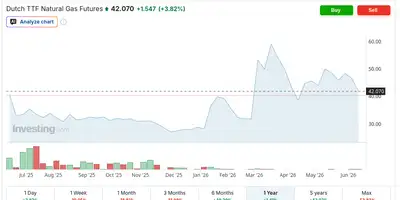
Europe's natural gas ticking time bomb has exploded. Again.
An outlook on the future of gas and electricity prices in Europe.
June 17, 2026
Q&A #1 with Team for the Planet
CO2 impact of diesel generators, 10-year total cost, end of life and deployment: detailed answers to the Team for the Planet assessment.
August 1, 2026